

St. Peter's Basilica Vatican Grottoes: Access, Tickets & What's Inside
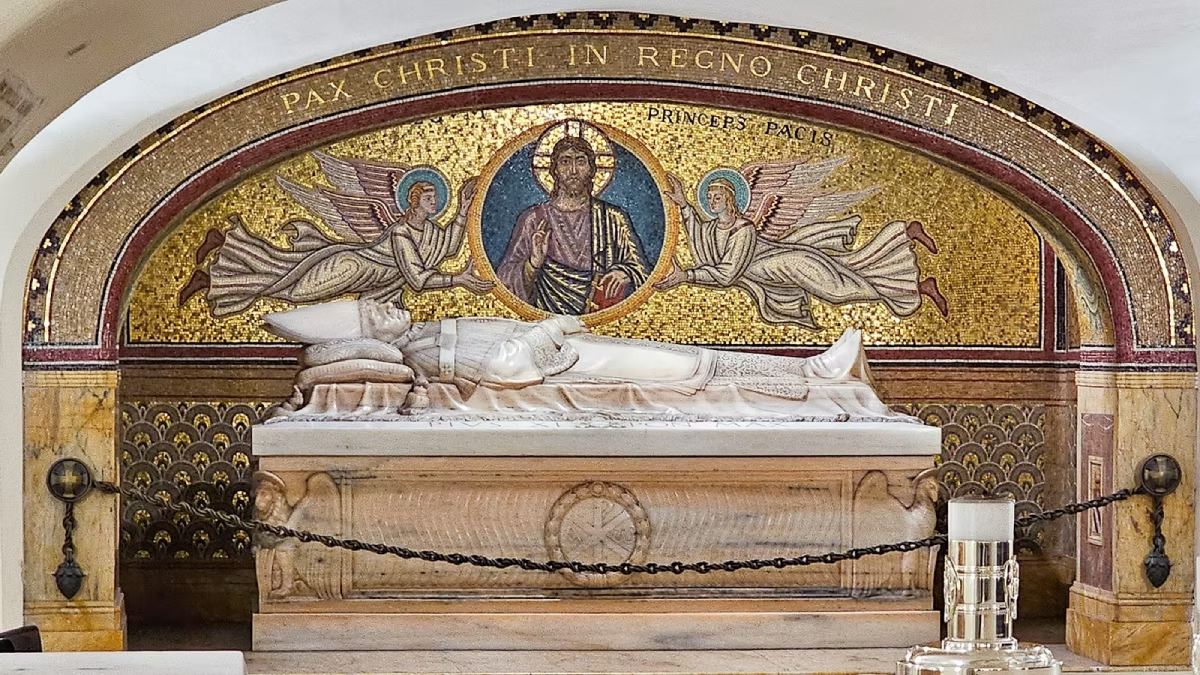
The Vatican Grottoes are free to visit and require no ticket or advance booking. They are located beneath St. Peter’s Basilica and are accessible from inside the church via a staircase near the main altar. Open daily from 09:00 to 18:00. Photography is strictly forbidden inside. The Grottoes house the tombs of over 91 popes, including St. John Paul II, as well as several royal figures and remnants of the original 4th-century Constantinian basilica.
Directly beneath the floor of St. Peter’s Basilica, a system of underground vaults stretches across the full width of the nave. This is the Vatican Grottoes — one of the most atmospheric and least crowded spaces in all of Vatican City. While the basilica above draws millions of visitors a day, the Grottoes below are frequently quiet, subdued, and deeply moving.
This guide covers how to access the Grottoes, what they contain, how they differ from the Vatican Necropolis (Scavi), and how to make the most of your time underground.
Are the Vatican Grottoes Free?
Yes — access to the Vatican Grottoes is completely free of charge. No ticket is required, no advance booking is needed, and there is no separate entrance fee. You simply need to enter St. Peter’s Basilica (also free) and make your way to the Grottoes entrance inside the church.
The Grottoes are open Monday to Sunday from 09:00 to 18:00, and the visit is self-guided. Note that photography is strictly prohibited inside, and visitors are expected to maintain silence throughout.
How to Access the Vatican Grottoes
The entrance to the Vatican Grottoes is located inside St. Peter’s Basilica, near the statues of St. Helena and St. Andrew at the base of the large pillars supporting the dome. You descend a staircase from the transept area of the basilica into the underground level.
Important: The Grottoes are a one-way circuit. Once you exit at the far end, you emerge outside the basilica — specifically near the colonnades of St. Peter’s Square. This means you cannot re-enter the basilica from the Grottoes exit without rejoining the security queue. Plan your visit to the Grottoes at the end of your time in the basilica, not the beginning, so you do not accidentally lock yourself out of the main church before you have finished seeing it.
The Vatican Grottoes are accessed from inside St. Peter’s Basilica. The entrance is near the statues of St. Helena and St. Andrew, close to the base of the four main pillars supporting the dome. You descend a staircase into the underground level. The visit follows a one-way route, and you exit near St. Peter’s Square — not back into the basilica. Visit the Grottoes at the end of your time inside the church.
What Is Inside the Vatican Grottoes?
The Papal Tombs
The primary draw of the Vatican Grottoes is the extraordinary concentration of papal burial sites. Over 91 popes are buried in and beneath St. Peter’s Basilica, with the majority of modern popes interred in the Grottoes themselves. The atmosphere is solemn and remarkably intimate — low ceilings, soft lighting, and marble slabs create a space that feels nothing like the grandeur of the basilica above.
Key tombs include:
Pope St. John Paul II — the most visited tomb in the Grottoes. After his beatification in 2011, his remains were moved to the Chapel of St. Sebastian in the basilica above for closer veneration, but his original burial site in the Grottoes remains a pilgrimage point. Queues often form here, especially in the morning.
Pope Pius XII — buried in a simple marble slab near the oratory that Pope Pius XII himself promoted, having overseen the mid-20th-century excavations that led to the discovery of the Vatican Necropolis and St. Peter’s tomb.
Pope Paul VI — buried in the Grottoes by his own specific request, in simple earth with no sarcophagus, as a statement of humility.
Pope John Paul I — the shortest-serving pope of the modern era (33 days), buried with quiet dignity in the Grottoes.
Royal burials — the Grottoes also house the tombs of Queen Christina of Sweden and Queen Charlotte of Cyprus, among other royal figures with historic ties to the Catholic Church.
The Clementine Chapel
At the heart of the Grottoes lies the Clementine Chapel — the most sacred space in the complex. Created by Pope Clement VIII in 1592, it is built directly above what is believed to be the exact location of St. Peter’s tomb. Inside the chapel is the chest that protects the sepulcher of the Apostle Peter, along with a fresco of the Madonna della Bocciata — a medieval image associated with a famous legend about a soldier and a miraculous wound. The chapel is the spiritual focal point of the entire Grottoes complex.
The Archaeological Rooms
Along the outer corridors of the Grottoes are six archaeological rooms containing fragments and remnants salvaged from the original 4th-century Constantinian basilica before it was demolished to make way for the current Renaissance building. Tombs, frescoes, mosaics, and architectural fragments from the old basilica are displayed here — a museum within a crypt, preserving what survived of the 1,300-year-old church that stood on this site before the one you walk through above.
Chapels of the Nations
Surrounding the central Clementine Chapel are a series of small national chapels added in the 20th century by Catholic communities around the world. These include the Irish Chapel (1954), the Polish Chapel (1958), the Lithuanian Chapel (1970), and the Mexican Chapel (1992), among others. Each represents a national Catholic community’s devotion to St. Peter and adds a quietly ecumenical layer to the Grottoes.
The Marble Statue of St. Peter
Near the exit of the Grottoes stands a marble statue of St. Peter enthroned — a piece distinct from the famous bronze statue in the basilica above. It depicts the Apostle in a position of authority, seated with his arms crossed, and serves as a fitting farewell image as you leave the underground.
Vatican Grottoes vs Vatican Necropolis (Scavi): What Is the Difference?
This is the most common point of confusion for visitors. They are related but entirely separate sites.
The Vatican Grottoes are the underground burial chambers built between 1590 and 1591 to support the floor of the current Renaissance basilica. They occupy the space between the ground floor of the basilica and the ancient Vatican Necropolis below. They are free, self-guided, and open to all visitors during basilica hours.
The Vatican Necropolis (Scavi) is a separate, 1st-century archaeological site located even deeper underground — beneath the Grottoes. It is an ancient Roman cemetery discovered during excavations ordered by Pope Pius XII in the 1940s. It contains what are believed to be St. Peter’s actual bones, identified through decades of archaeological investigation. Access to the Necropolis requires a separately booked, authorised tour through the Vatican Excavations Office (Ufficio Scavi), operates with very limited capacity, and typically needs to be reserved 2–3 months in advance.
If you want to stand where St. Peter himself is believed to be buried, the Necropolis tour is what you need — not the Grottoes. For full details, see: St. Peter's Basilica Necropolis (Scavi): Tickets, Tour & What to Expect.
The Vatican Grottoes are the free, publicly accessible underground burial chambers beneath the basilica floor, built in the late 16th century and housing over 91 papal tombs. The Vatican Necropolis (Scavi) is a separate 1st-century Roman cemetery discovered in the 1940s, located even further underground, containing the believed tomb of St. Peter. The Necropolis requires an advance booking and a separate fee; the Grottoes do not.
Tips for Visiting the Vatican Grottoes
Visit at the end of your basilica tour. Because the exit leads outside the basilica, you cannot re-enter without rejoining security. Make the Grottoes your final stop.
Go before 9am or after 4pm. The tomb of St. John Paul II in particular draws sustained crowds throughout the day. Early morning or late afternoon is the best time for a quiet, unhurried visit.
Photography is forbidden. This rule is enforced. Do not attempt to photograph inside the Grottoes — it is considered disrespectful and staff will ask you to leave.
Maintain silence. The Grottoes are an active sacred space. Visitors are expected to move quietly and respectfully throughout.
Accessibility is limited. The Grottoes are accessed via a staircase, which makes them difficult for visitors with mobility impairments. There are no lifts to the underground level. The Vatican’s accessibility page should be consulted in advance if this is a concern.
Allow 30–45 minutes. The circuit is not long, but the density of the tombs and the atmosphere of the chapels encourages slow movement. Rushing through the Grottoes misses the point.
Frequently Asked Questions
Are the Vatican Grottoes free?
Yes. Access to the Vatican Grottoes is completely free of charge. No ticket or advance booking is required. You enter from inside St. Peter’s Basilica and exit near St. Peter’s Square.
Where is the entrance to the Vatican Grottoes?
Inside St. Peter’s Basilica, near the statues of St. Helena and St. Andrew at the base of the pillars supporting the dome. Look for the staircase leading downward in the transept area.
Can you see St. Peter’s tomb in the Vatican Grottoes?
Not directly. The Clementine Chapel in the Grottoes is built above the believed location of St. Peter’s tomb, and you can visit the chapel itself. However, St. Peter’s actual remains and the first-century necropolis are located further underground, accessible only via the separately booked Vatican Necropolis (Scavi) tour.
Is photography allowed in the Vatican Grottoes?
No. Photography is strictly forbidden throughout the Vatican Grottoes. This rule is enforced by staff and is non-negotiable.
How long does a visit to the Vatican Grottoes take?
Most visitors spend 30–45 minutes in the Grottoes. The route is linear and not particularly long, but the density of tombs and chapels, and the quiet atmosphere, tends to slow visitors down naturally.
Is St. John Paul II buried in the Vatican Grottoes?
His original burial site was in the Grottoes, and it remains a pilgrimage point. After his beatification in 2011, his remains were transferred to the Chapel of St. Sebastian on the main floor of the basilica. Both locations are visited by pilgrims.
What is the difference between the Vatican Grottoes and the Scavi?
The Grottoes are the free, publicly accessible 16th-century underground burial area. The Scavi (Vatican Necropolis) is a 1st-century Roman cemetery located even deeper underground, accessed via a separate tour that must be booked in advance. See our full guide: St. Peter’s Basilica Necropolis (Scavi): Tickets, Tour & What to Expect.
Do guided tours of St. Peter’s Basilica include the Grottoes?
Many do, but not all. Check your tour’s inclusions before booking. Some tours list the Grottoes as a highlight; others cover only the main basilica floor. See our full comparison: St. Peter’s Basilica Guided Tours: Which One Is Worth It?
