

St. Peter's Basilica with Kids: Tips for Families
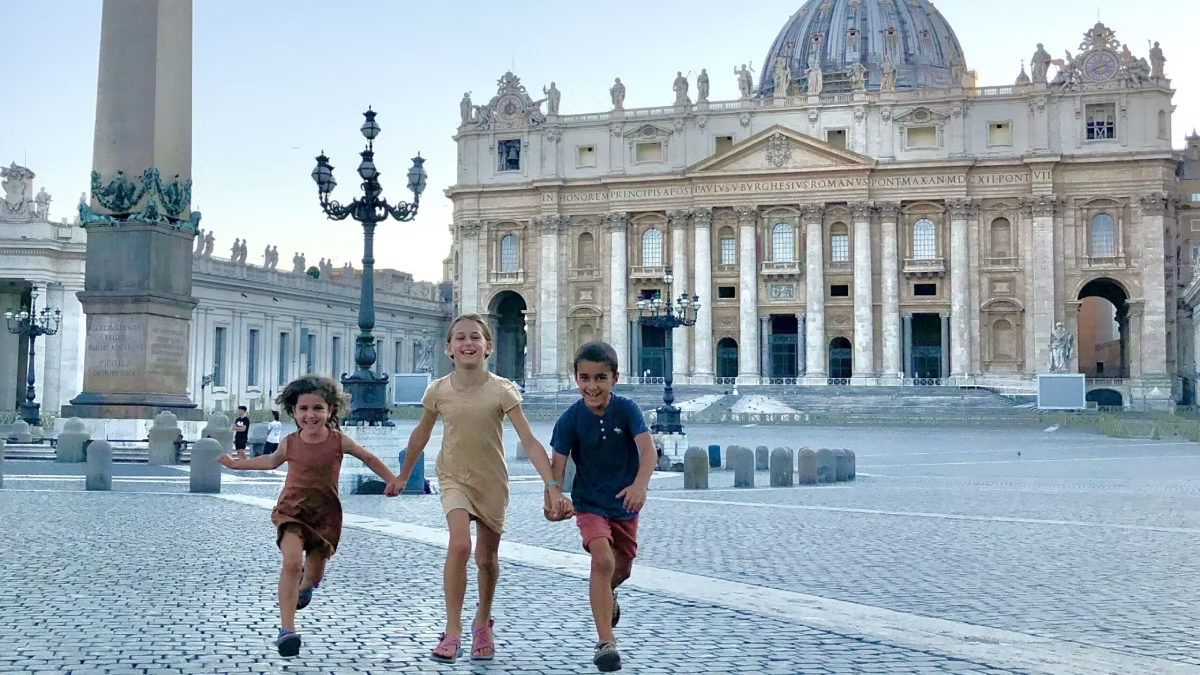
St. Peter’s Basilica is free for all ages and genuinely accessible for families with children of most ages. Strollers must be left at the storage area in the basilica portico before entering — bring a baby carrier for infants and toddlers who cannot walk the full distance. The dress code applies to children too: shoulders and knees must be covered. Arrive early (before 9am) to minimise queue times and heat. The dome climb is suitable for children aged 7 and over, and is not recommended for younger children or those with mobility concerns.
St. Peter’s Basilica may not be the first destination that comes to mind for a family visit, but it surprises many parents. Entry is free, the interior is vast enough that children can move around without feeling trapped, the Pietà and Baldachin are genuinely impressive at any age, and the dome offers views over Rome that older children and teenagers consistently enjoy. With some advance planning — particularly around timing, strollers, and dress code — it is a manageable and often memorable visit for families.
Is St. Peter’s Basilica Suitable for Children?
Yes — with realistic expectations. The basilica is not a museum with interactive exhibits or child-focused programming. It is a working church with some of the most significant religious art in the world. Children under 5 will not understand the artworks but can be overwhelmed by the scale and the atmosphere in a positive way. Children aged 6–10 can follow simple explanations and tend to respond well to the physical drama of the space — the enormous columns, the golden mosaics, the bronze statue of St. Peter. Older children and teenagers, particularly those with any interest in art, history, or architecture, can find it genuinely fascinating.
The visit is manageable in time — 60–90 minutes for the main floor is achievable for most children without becoming exhausted. Adding the dome climb for older children adds another 45–60 minutes. The Grottoes are a short additional experience that children often find intriguing — the underground atmosphere and the papal tombs have a quality that engages curious younger visitors.
Entry: Is It Free for Children?
Yes. Entry to the main basilica floor is completely free for all visitors of any age. There are no children’s tickets, no age limits for free entry, and no booking required for children. The dome climb costs the standard price regardless of age.
Strollers: What You Need to Know
Strollers are not permitted inside the basilica. The official Vatican policy states that strollers must be left at the dedicated stroller storage area, located in the basilica portico. The area is accessible via a dedicated ramp from the parvis (the large paved area in front of the basilica) as well as via steps.
Once the stroller is stored, families begin their visit from the Vatican Grottoes entrance (the Welcome Desk), which is the starting point for the official digital audio guide route.
Practical advice: A soft baby carrier or ergonomic backpack carrier is the most practical solution for very young children (infants and toddlers). It keeps your hands free, allows easy navigation through security, and eliminates the need to store anything. For children who can walk, the basilica floor is smooth and flat, making it easily manageable on foot.
St. Peter’s Square and the approach: Strollers are perfectly fine in St. Peter’s Square and along the approach to the basilica. The security queue snakes along the colonnade, and having a stroller during this wait is actually convenient — it gives young children somewhere to sit.
Strollers must be left at the stroller storage area in the basilica portico before entering. They are not permitted inside the basilica itself. The storage area is accessible via a ramp. A baby carrier is the most practical alternative for infants and toddlers inside the basilica. Strollers are freely usable in St. Peter’s Square and during the external security queue.
Dress Code for Children
The dress code applies to children as it does to adults — shoulders and knees must be covered. For summer visits, practical options include:
- For boys: lightweight trousers or long shorts, and a short-sleeved top
- For girls: a knee-length dress or skirt with a top that covers the shoulders, or lightweight trousers with a T-shirt
Bringing a light scarf or extra layer as backup is always worth doing, especially in summer when children are likely to be dressed for the heat. Scarf solutions at the gate work for children the same way they do for adults — a large scarf wrapped around the waist covers a short skirt or shorts effectively.
For full dress code details, see: St. Peter's Basilica Dress Code
Best Time to Visit with Children
Early morning is strongly recommended. Arriving between 7am and 9am means shorter or no security queues, a cooler interior (critical in summer), and fewer crowds — which means children have more physical space and a less overwhelming sensory experience. The silence and spaciousness of the basilica in the early morning is a genuinely different experience from the midday crush.
Avoid peak hours (10am–2pm): The basilica is at its most congested during this window. Young children can find heavily crowded spaces distressing, and the heat from hundreds of bodies in a summer basilica is significant.
Avoid Wednesday mornings: The basilica is closed to tourists on Wednesday mornings for the Papal General Audience. See: St. Peter's Basilica Opening Hours
Plan for a short visit: For families with children under 8, 60–90 minutes is a realistic maximum for the main floor before attention and energy start to flag. Do not overplan — it is better to leave wanting more than to stay past the point where children are struggling.
What Children Tend to Enjoy Most
Michelangelo’s Pietà — most children, even those with no art background, respond to the emotional directness of this sculpture. The glass barrier and the scale of the chapel create a natural focal point that draws children’s attention.
The Baldachin — the sheer size of Bernini’s bronze canopy (29 metres — taller than a 10-storey building) consistently impresses children. The twisted bronze columns and the scale relative to the people standing beneath it are immediately comprehensible as remarkable.
The bronze Statue of St. Peter — the worn right foot, polished smooth by centuries of pilgrim touches, is a tangible, tactile piece of history that children find engaging. Many want to touch it themselves (which is perfectly fine — this is its purpose).
The dome (viewed from below) — standing at the crossing and looking up at the interior of Michelangelo’s cupola, with its golden mosaics and the drum of windows letting in light, is a genuinely awe-inspiring sight for children who like things that are big.
The Vatican Grottoes — the underground atmosphere, the papal tombs, and the sense of being beneath the basilica floor is an experience that curious children of 7 and above often find compelling. Younger children may find it slightly spooky; this depends on the individual child.
The Dome Climb: Is It Suitable for Children?
Age recommendation: The official Vatican guidance states the dome climb is not recommended for children under 7. The upper section of the dome — the final 320 steps between the inner and outer shell — is narrow, steep, and angled. It can feel genuinely claustrophobic for adults; for anxious or young children, it is not appropriate.
For children aged 7–12: The dome climb with the elevator (to the roof terrace) is usually manageable and greatly enjoyed, particularly the views at the top. The remaining 320 stairs from the terrace upward should be assessed based on the individual child’s confidence and fitness. Some children of 10–12 are enthusiastic climbers; others find the narrow sections uncomfortable.
For teenagers: The dome climb is almost universally popular with teenagers. The physical challenge and the dramatic views make it one of the highlights of a Rome trip for this age group.
For all the details on the dome experience: St. Peter's Basilica Dome Climb: Tickets, Tips & What to Expect
Practical Tips for Families
Feed and water children before the visit. Food and drinks are not permitted inside the basilica. Baby bottles with milk are also technically not permitted, though a nursing mother can breastfeed discreetly inside (a nursing cover is advisable). The portico area and the space near the stroller storage have some seating where you can prepare children before entering.
Baby-changing facilities are available in the Welcome Area inside the basilica portico. The official Vatican FAQ confirms a room with a changing table is located in this area.
Toilets are located near the Welcome Area and in other parts of the complex. Use them before beginning your visit — there are no restrooms within the main basilica floor itself.
Keep mobile phones on silent. The basilica is an active place of worship. Children should be briefed before entering that loud voices, running, and phone use during any active Mass are not appropriate.
Consider a private guided tour if you have a specific age group or area of interest in mind. Private tours can adjust pace and content to suit your family, spending more time on the Pietà if your children are interested in sculpture, or more time in the Grottoes for children who enjoy underground archaeology. See: St. Peter's Basilica Guided Tours: Which One Is Worth It?
Skip-the-line tickets are particularly valuable for families. Queueing in the sun for 60–90 minutes with young children is genuinely exhausting. A reserved entry ticket or guided tour moves you into the priority lane and reduces the queue to 10–15 minutes. In peak season, this alone can make the difference between a good and a difficult visit.
Frequently Asked Questions
Is St. Peter’s Basilica free for children?
Yes. Entry is free for all ages. There are no children’s tickets and no age restrictions for free entry.
Are strollers allowed in St. Peter’s Basilica?
No — strollers must be stored in the portico storage area before entering. A baby carrier is the recommended alternative inside the basilica.
What age is suitable for the dome climb?
The dome climb is not recommended for children under 7. For children aged 7 and over, the elevator option (to the roof terrace, then approximately 320 stairs) is manageable for most healthy children. The full stair route (551 steps) is more demanding.
Does the dress code apply to children?
Yes. Shoulders and knees must be covered for all visitors, including children.
Is there anywhere to feed a baby or change a nappy?
Yes. A baby-changing room is located in the Welcome Area inside the basilica portico. Breastfeeding inside the basilica is permitted discreetly.
How long should we plan for a family visit?
For families with young children, 60–90 minutes for the main floor is realistic. Add 30–45 minutes if visiting the Vatican Grottoes and 45–60 minutes if older children are doing the dome climb.
Can babies and toddlers skip the security queue?
Some families travelling with very young babies report being waved through security by guards, though this is at the guard’s discretion and not guaranteed. Booking a reserved entry ticket is a more reliable way to minimise queue time for all family members.
