

St. Peter's Baldachin by Bernini: What It Is & Why It Matters
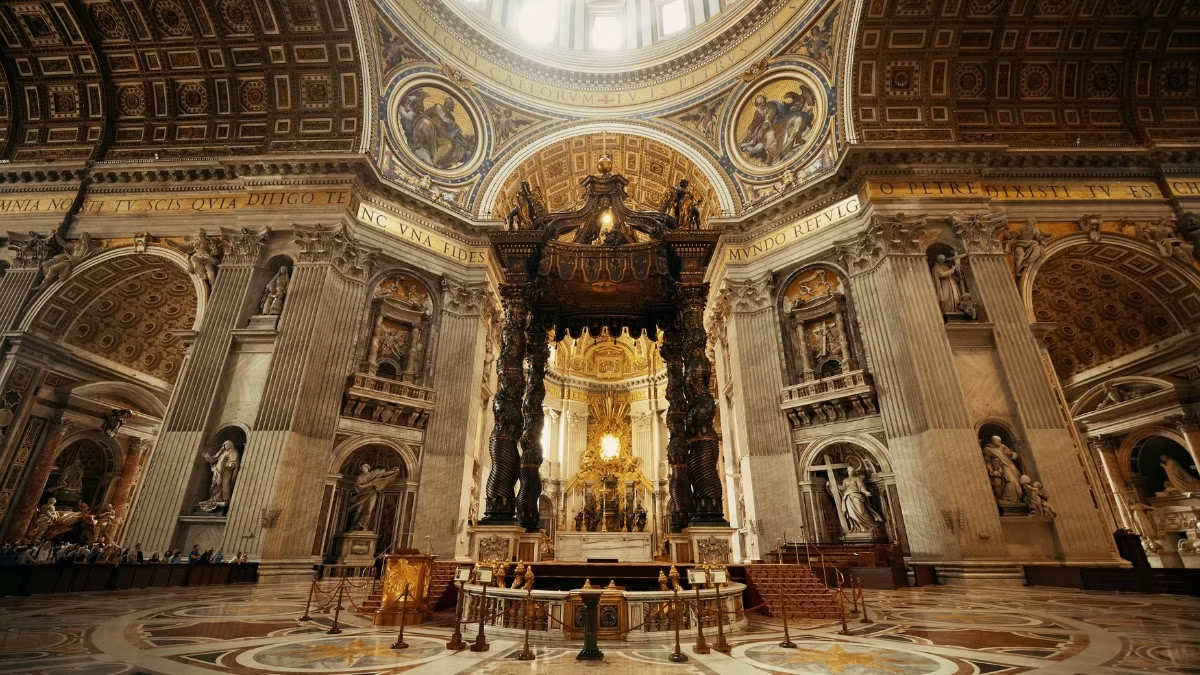
The Baldachin (Baldacchino) is a gilded bronze canopy standing 29 metres tall at the centre of St. Peter’s Basilica, directly over the papal altar and above the believed tomb of St. Peter. Designed by Gian Lorenzo Bernini and built between 1623 and 1634, it is the largest bronze object in the world. Its four twisted Solomonic columns, four life-size angels, cherubs, and gilded crown are visible from across the basilica and serve as its visual focal point.
The Baldachin is the first thing most visitors notice after the sheer scale of the space. It stands at the heart of the basilica — at the point where the nave meets the transept, directly below the dome — and it is enormous. At 29 metres, it is taller than an 8-storey building. Yet the genius of its design is that in a building scaled to make everything look modest, the Baldachin manages to feel both monumental and delicate simultaneously. This guide explains what it is, how it was made, and what it means.
What Is a Baldachin?
A baldachin (also spelled baldacchino or baldaquin) is a canopy placed over a throne, altar, or person of sacred significance. The word derives from “Baldacca” — the medieval Italian name for Baghdad, from which the sumptuous silk brocade used to make early canopies was imported. A cloth canopy suspended over a throne or altar was a universal sign of authority and sanctity across medieval Europe and the Byzantine world.
By Bernini’s time, permanent stone or metal ciborium structures had largely replaced cloth canopies in major churches. But Bernini did something unprecedented: he used heavy bronze to simulate the softness of cloth. The Baldachin’s canopy top — its most distinctive visual element — mimics the draped fringe of a fabric canopy, tassels and all, rendered in solid gilded metal. The effect is one of apparent weightlessness in a material that weighs 63 tonnes.
The Commission and Construction
Pope Urban VIII (1623–1644), born Maffeo Barberini, commissioned the Baldachin shortly after his election. He chose Gian Lorenzo Bernini — then 25 years old and already regarded as the most gifted sculptor in Italy — for the project.
Construction began in 1623 and was completed in 1634, taking approximately nine years. Bernini worked alongside his father Pietro Bernini and his brother Luigi, with additional contributions from Francesco Borromini (who made drawings and may have contributed to the structural design), Giuliano Finelli, François Duquesnoy, Andrea Bolgi, and Stefano Maderno. It was Bernini’s first commission in the basilica — the project that established his relationship with St. Peter’s and with the papacy, and launched the career of the defining artist of the Roman Baroque.
The Baldachin was inaugurated on 29 June 1633 (the Feast of Saints Peter and Paul), though work continued for another two years. A major restoration was undertaken in the 18th century (1758), and the most recent comprehensive restoration — funded by the Knights of Columbus at a cost of approximately €700,000 — was completed before Bernini’s work was revealed in its original gilded glory.
The Bronze: The Pantheon Controversy
The Baldachin required an extraordinary quantity of bronze. The source of that bronze became one of the most notorious acts of spoliation in Roman history. Pope Urban VIII authorised the removal of bronze from the ceiling of the Pantheon’s portico — an ancient Roman temple that had survived 1,500 years as a Catholic church, its original classical structure intact.
Approximately 200 tonnes of bronze were stripped from the Pantheon. Some of this was used for the Baldachin’s columns and decorations; the rest was reportedly melted down for cannon. The scandal provoked a famous satirical graffito left on the ancient speaking statue of Pasquino in Piazza Navona:
“Quod non fecerunt barbari, fecerunt Barberini.” “What the barbarians did not do, the Barberini did.”
(A reference to the Pope’s family name — Barberini — and to the fact that barbarian invaders had left Rome’s monuments more intact than this papal remodelling project.)
The accusation was not entirely fair — historical research suggests much of the Pantheon bronze went into cannon rather than the Baldachin, and Bernini may have sourced significant quantities from Venice. But the satirical point stuck, and “What the barbarians did not do” remains in popular consciousness as a summary of the entire episode.
The Baldachin (Baldacchino) is a 29-metre gilded bronze canopy designed by Gian Lorenzo Bernini and built between 1623 and 1634. It stands at the centre of St. Peter’s Basilica directly over the papal altar and above the believed tomb of St. Peter. It is the largest bronze object in the world. Its four twisted Solomonic columns support a draped canopy crown topped by an orb and cross.
The Four Solomonic Columns
The most immediately striking element of the Baldachin is its four twisted columns. Each rises 20 metres from its marble pedestal, spiralling upward in a form known as Solomonic — a reference to the tradition (erroneous, as it turns out) that the original marble columns in the old Constantinian basilica had been taken from the Temple of Solomon in Jerusalem.
The original twelve Solomonic columns from the old basilica are still visible in pairs halfway up the four massive piers supporting the dome — Bernini’s bronze columns were designed in explicit homage to them, scaled up to match the dimensions of the new building. Eight of the original columns can be seen from the crossing area, flanking the medallions of the Four Evangelists on the piers.
Each bronze column is decorated with laurel branches, olive twigs, and cherubs climbing through the foliage. They were cast in three sections for practical reasons and partially filled with concrete for stability. The spiral movement of the columns creates a sense of upward energy and animation that is the defining visual signature of the entire Baroque programme at St. Peter’s.
The Canopy and the Angels
At the top of the four columns, a deeply curved cornice supports the canopy crown — the baldachin itself. The crown mimics the draped and fringed fabric of a ceremonial tent, with bronze tassels hanging from each corner. Four large life-size angels (approximately 4 metres tall, weighing about 2.5 tonnes each) stand at the four corners of the cornice, holding laurel wreaths and gazing toward the papal altar below. Between the angels, pairs of putti hold the instruments of papal and apostolic authority — the Keys of St. Peter and Tiara on two sides, the Sword and Book of St. Paul on the other two.
The inner ceiling of the canopy is made of gilded wood — a practical concession in a structure that already weighs 63 tonnes. A dove representing the Holy Spirit, surrounded by acanthus leaves and Barberini bees, occupies the centre of the gilded ceiling.
At the very top, a gilded orb supports a cross — the final symbol of Christ’s dominion over the world.
The Barberini Bees
Throughout the Baldachin, almost obsessively, appear the heraldic bees of the Barberini family. Three bees on a blue background was the Barberini coat of arms, and Pope Urban VIII commissioned Bernini not only to create a masterwork for the church but to make sure it was legible as a monument to his own family’s patronage. The bees appear on the column plinths, in the canopy decorations, on the heraldic shields, and in the inner ceiling. Whatever its spiritual programme, the Baldachin is also a 29-metre advertisement for the Barberini papacy.
The Mysterious Childbirth Sequence
One of the most intriguing and least-discussed aspects of the Baldachin is the sequence of eight women’s faces carved on the outer faces of the four marble pedestal plinths. Beginning at the south-east pedestal and proceeding clockwise, the faces show a woman in progressively more extreme expressions — from calm, through discomfort, through apparent agony, to bliss — culminating in the final pedestal which bears not a woman’s face but the face of a baby.
The sequence has been interpreted as a representation of childbirth. Various theories account for it: a popular tradition holds that it depicts a complicated pregnancy of a niece of Urban VIII’s, for whom the Pope made a vow to St. Peter. Scholarly interpretations suggest it represents the labour of Mother Church bringing forth salvation — a theological allegory of the papacy’s mission. Whatever its origin, the sequence is one of the strangest and most human elements in the entire basilica.
The Baldachin as Visual Mediator
Beyond its symbolic and aesthetic properties, the Baldachin serves a specific spatial function. St. Peter’s Basilica is so large that the human body is barely legible at the crossing — visitors at the far end of the nave appear as tiny figures. The Baldachin provides a visual scale at the centre of the space: its angels and columns give the eye something to measure, something that confirms the basilica’s extraordinary dimensions while making them comprehensible at a human level.
Bernini himself articulated this function: the Baldachin was designed to mediate between the enormous scale of the building and the human scale of the people celebrating Mass beneath its canopy. Without it, the crossing would feel empty and the papal altar — the most sacred point in the basilica — would be invisible from the nave. The Baldachin makes the centre visible, draws the congregation’s attention to it, and gives the space its focal point.
What to Look For When You Visit
Walk around all four sides. The Baldachin looks dramatically different from the nave approach, from the transept, and from the apse. The columns spiral in different directions depending on which side you approach from. Walking a full circuit gives you the complete spatial experience.
Look at the plinth faces. Find the eight carved women’s faces on the pedestals and follow the sequence clockwise from the south-east pedestal to observe the full childbirth progression.
Notice the Barberini bees. Once you know they are there, you will see them everywhere on the structure — in the decorative foliage, on the shields, in the cornice.
Look up through the canopy. From directly below the Baldachin, looking straight up through the bronze crown gives you the gilded interior ceiling with the dove and the acanthus decoration — a view completely different from any other angle.
Compare scale. Stand beneath the Baldachin and look up at the dome above it. The dome is visually overwhelming; the Baldachin seems almost modest by comparison. Then look back down the nave toward the entrance. The Baldachin is now the largest object in your field of vision. The relationship between the two is the spatial argument of the entire building.
Frequently Asked Questions
What is the Baldachin in St. Peter’s Basilica?
A 29-metre gilded bronze canopy designed by Bernini, standing over the papal altar at the crossing of the nave and transept. It is the largest bronze object in the world and marks the position above St. Peter’s believed tomb.
Why did Bernini use the Pantheon’s bronze for the Baldachin?
Pope Urban VIII authorised the removal of approximately 200 tonnes of bronze from the Pantheon’s portico ceiling to provide material for the Baldachin and other Vatican projects. The act provoked strong public criticism. Some scholars argue a substantial portion of the bronze went to cannon rather than the Baldachin.
How long did it take to build the Baldachin?
Approximately nine years, from 1623 to 1634. It was Bernini’s first major commission in St. Peter’s Basilica and established his role as the defining artistic voice of the Roman Baroque.
How tall is the Baldachin?
29 metres — approximately equivalent to an 8–9 storey building. It weighs approximately 63 tonnes.
What are the twisted columns of the Baldachin called?
Solomonic columns — a reference to the tradition that the original Constantinian columns they were modelled on came from Solomon’s Temple. The spiralling form became synonymous with Bernini’s Baroque style.
What is the significance of the bees on the Baldachin?
The bees are the heraldic symbol of the Barberini family, to which Pope Urban VIII belonged. Their pervasive presence on the Baldachin reflects the Pope’s desire to associate his family with this monumental commission.
